
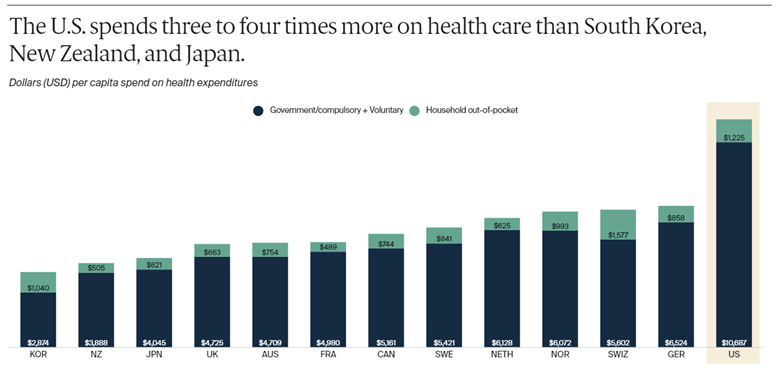
The US spends two to four times as much as other leading nations on healthcare. While I was not surprised that the wealthiest nation on earth spends the most on healthcare, I was surprised just how much more we spend per person. This chart shows a comparison for 2022 healthcare spending per capita.
What We Get for that Money
Since we spend so much more, you would expect that we get significantly better results. If you look at life expectancy, avoidable deaths, infant mortality, and maternal mortality, our results are the worst of these major developed democracies by far…and we are falling further behind over time. Of all these countries, we are the only one that doesn’t cover everybody…we still have 26 million people (7.7% of our population) without healthcare coverage in 2024.
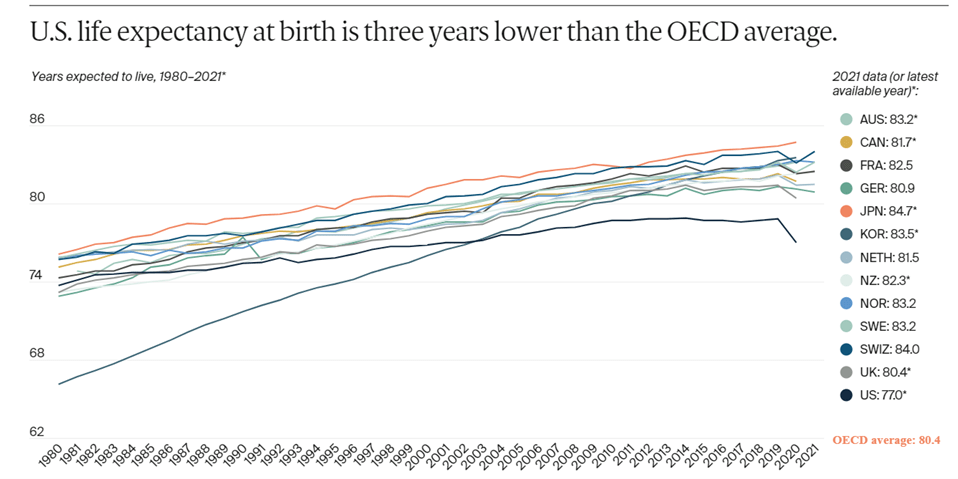
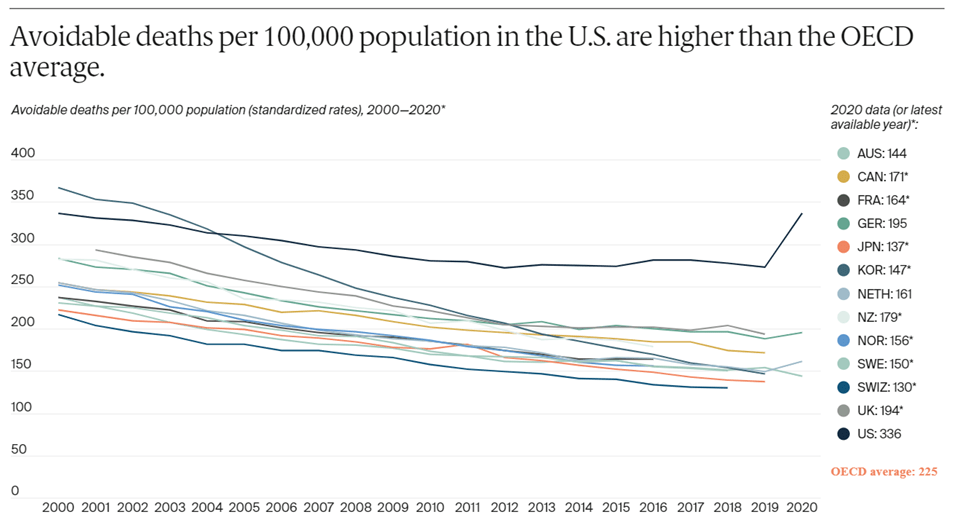
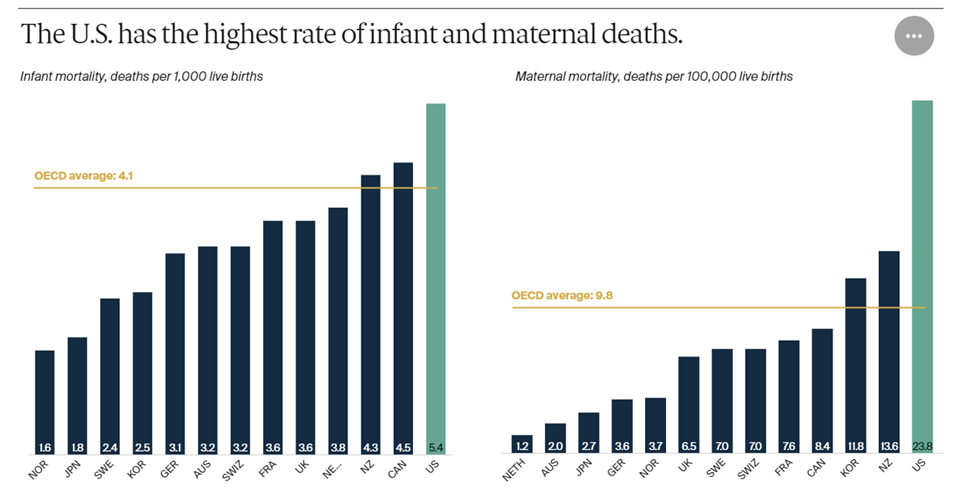
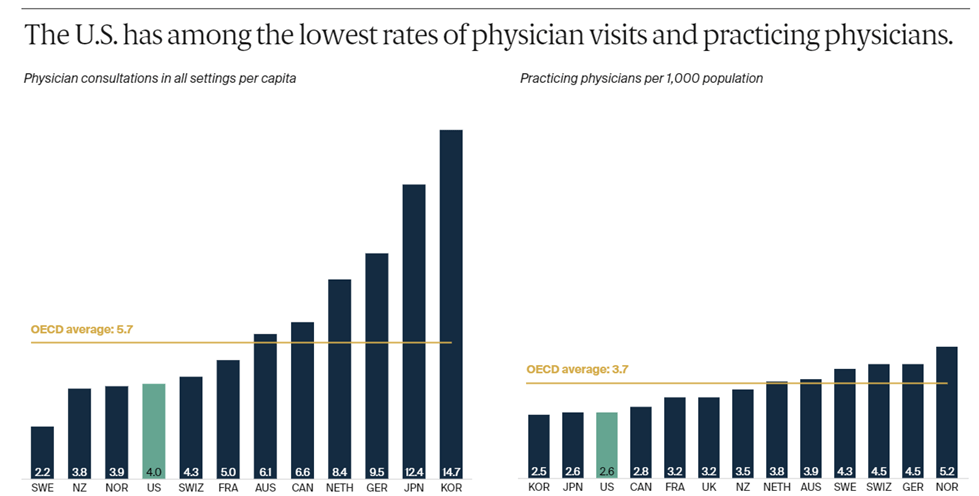
Is our extra expense buying us more access to physicians and visits with our doctors? No. We are near the bottom of this group in physician consults and practicing physicians per capita.
Where is the Money Going?
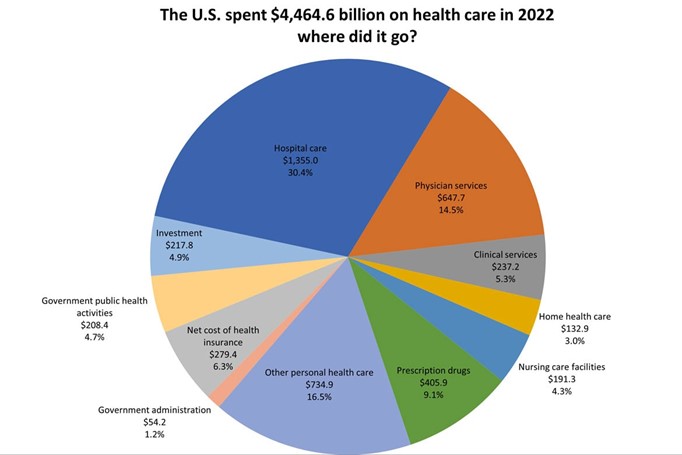
Since we are paying so much more than other countries and getting relatively poor outcomes, there must be a big opportunity for improvement. If we can understand where the money is going, maybe we can find opportunities to reduce the cost. Medicare and Medicaid are the number 2 and 3 line items in our federal budget, so if we can bring our costs down while maintaining or improving health outcomes, it could be a major enabler for balancing our budget. Breakdowns of spending to their major categories are readily available, like this one from 2022.
To really find the potential efficiencies, we need to track spending to lower levels to see what the money is going within these categories. That info is not readily available, but a study by the Commonwealth Fund compared the US expenses to those of other countries and identified the following areas of excess spending:
Components of Excess U.S. Health Spending and Estimated Shares
| Component | Share of excess spending |
| U.S. pays more in administrative costs of insurance | ~15% |
| U.S. providers spend more on administrative activities | ~15% |
| U.S. pays more for prescription drugs | ~10% |
| U.S. physicians earn more | ~10% |
| U.S. registered nurses earn more | ~5% |
| U.S. invests more in medical machinery and equipment | <5% |
| Sum of components estimated | ~60% |
This identifies some of the most obvious areas where we directly spend more, although it does not explain all the excess spending. Reducing our costs can’t be achieved by simply cutting spending in these areas. Our hospitals and doctors are already feeling financially squeezed as their costs are increasing faster than their revenue. There are structural inefficiencies built into the system, and reducing costs requires more structural changes.
We Have the Capability to Be the Best

We have great doctors, amazing innovators, some of the best healthcare technology…I firmly believe that we have the knowledge and the resources to lead the world in health outcomes. I also am confident that we can use our American ingenuity to achieve those great results at a lower cost. After looking at this in detail, I see the five main reasons we are not currently achieving our potential in terms of outcomes vs expense as:
- Complexity – Our healthcare system is extremely complex, with lots of redundancy and administrative burden.
- Incentives – Healthcare is big business, but not an effective free market. Making people healthier is often at odds with making profits. We need to align incentives so that everyone benefits when people are healthy.
- Coordination – This varies greatly depending on the setting, but in many complex cases our care is very fragmented, and symptoms are addressed individually instead of working as a team to care for the patient’s overall health.
- Coverage – We still have amost 8% of people without health insurance coverage.
- Lifestyle – Many Americans have high work stress, unhealthy eating habits, and lead relatively sedentary lives.
If we can restructure the system to reduce complexity, align incentives, and provide more coordinated proactive care, I believe we can cover everyone and achieve world class levels of health and life expectancy at a competitive cost.

I do think there is an important lifestyle aspect, and each of us should try to live, eat, and work in a healthy way…for our own benefit and to do our part to reduce the overall healthcare costs that must be funded.
Complexity Drives Cost
We have at least 5 different types of payer systems for different segments of our population. All of these systems have to be managed and administered. Providers need to deal with multiple systems with different structures.

- VA system – Government run medical care
- Medicare/Medicaid – Single payer with private providers
- Medicare Advantage – Mix of public/private payers
- Employment based insurance – Private insurance through employers
- Government insurance exchange – Private insurance marketplace
- No Insurance – Paid out of pocket
Within the private insurance space, there are more than 1,100 companies that provide healthcare coverage. We have over 400 healthcare systems that include over 6,200 hospitals and 640,000 ambulatory care settings. Each of these have administrative costs, marketing costs, IT costs, etc. The insurance companies negotiate different reimbursement rates for every medical service with the different healthcare providers. Just imagine the amount of time and resources spent negotiating rates between all of these entities, and then dealing with the resulting beaurocracy.

The US is the only country that primarily provides healthcare insurance through employers. We have over 33 million businesses, and over 50% offer healthcare insurance for their employees. By involving businesses in the process, insurance companies now need to deal with millions of businesses in addition to the individuals they insure. Employment based insurance has other down sides, such as increased administrative burden for employers, challenging costs for small businesses, and lack of healthcare for unemployed people.
Since there are so many insurance companies with different policies, doctors and their staff commonly need to contact insurance companies for prior authorization to make sure a procedure is covered before performing it. This time consuming process causes a drag on the system, reduces productivity, and can cause delays in care.
All of this complexity results in unnecessary cost. We need to look at structural changes to largely reduce this complexity and provide good care at much lower cost.
Not an Effective Market

Have you ever shopped for healthcare by price? Most of the time healthcare consumers don’t know the price until after they receive the service. And even after the service, the bill usually needs to go to the insurance company, where it gets modified based on contractual agreements, the insurance company pays their part, and weeks later the patient finds out what they owe. For some elective procedures, it may be possible to research costs to find a lower price, but it is not easy. In January 2021, the Hospital Transparency Rule went into effect by executive order, requiring hospitals to disclose pricing for some services…a step in the right direction, but the lists are sometimes buried or incomplete. Even if you do know the price difference, your doctor has certain preferred specialists, surgeons, and labs that they recommend…and trust is very important when dealing with your health. Certainly, in an emergency, you are not going to take time to consider your price options.

Private equity firms have been pouring money into health care, looking to buy up specialties where patients have little choice, such as anesthesiologists, and then jacking up prices. Pharmaceutical companies have been creating patent chains that last for many years, and raising prices on established life-saving drugs like Epi-pens to more than 20 times their cost. We need to curb these abuses of the system, which are milking it for big corporate profits, and driving up the cost for us all.
With a lack of real price transparency, restrictions based on insurance rules and provider networks, most payments coming through insurance, and healthcare needs you can’t live without, the health marketplace is not a free market. In some areas, there are few providers and you have an effective monopoly, resulting in even higher prices. Healthcare is one area where a market won’t naturally drive efficiency – we need to be smarter about how we get good outcomes at an effective cost.
Aligning the Incentives

Healthcare in the United States is largely funded by a “Fee for Service” model. When we have a doctor visit, procedure, surgery, or test, we pay a fee. It makes basic sense – you get a healthcare service, you pay the provider. However, the person recommending whether a procedure, surgery, test, or return visit is necessary is the same person or organization that will profit from those services. They have an incentive (consciously or subconsciously) to recommend as much care as reason allows. In the worst extreme cases, you have cancer doctors that have been found guilty of performing radiation procedures on people that didn’t really have cancer. While these cases are rare and most doctors are trying to best care for their patients, if there is a question about whether a procedure or surgery will be beneficial, the incentives for the healthcare providers align with more care and higher expense.

If a doctor fixes your health problem, or cares for you in a way that prevents your health problem, they get the reward of knowing they did a good job, and possibly some future referrals…but financially they get less direct income than if you have continued problems and return visits. However, there is a sizable push toward “Value Based Care” models instead of “Fee for Service,” particularly for primary care. In a Value Based Care model, doctors receive a certain amount of money to keep people healthy. If they prevent health problems and avoid expensive care like hospitalizations, they pocket more money. Value Based Care models are a promising way to align incentives around efficiently keeping people healthy, and there is a lot of innovation happening in this space. We need to make sure the savings are achieved by better preventative care and not by cutting care that is necessary. As we look to find a better model of health care funding, we need to avoid making the system even more complex and driving up overall cost.
Need for Coordination of Care

One major area of opportunity on the quality side is improving coordination between the providers that are involved in each patient’s care…particularly for those complex patients that require the most care. The current health care system can often seem like a maze, and you practically need to know someone with a healthcare background that can help navigate that system and connect the dots. As we look at Value Based Care models, we should also look to incentivize providers to work together as a team to deliver the health of the whole person. People often talk about Primary Care Physicians as a “quarterback” that can manage the overall care for their patients. This can be an effective approach, but we need to recognize the value in that coordination effort and compensate Primary Care provider for that critical function. We are on track for a severe Primary Care Physician shortage due to the relatively higher salaries paid to specialists…we are paying the “quarterbacks” much less than the “wide receivers”. If primary care docs feel a need to see 40 patients a day to make a competitive salary, that doesn’t leave time for coordination and follow-up.
Electronic Medical Records

The American Recovery and Reinvestment Act of 2009 required the migration to Electronic Medical Records, with the goal to improve quality, safety, efficiency, care coordination, and privacy. If done right, EMR has huge potential to deliver these goals, but the implementation so far has added a lot of complexity, inefficiency, and cost. EMR systems can cost over $100,000/year per doctor. There are over 1,000 vendors providing Electronic Medical Records software, with a wide range of quality. All of these companies have administration and staffing expenses. Many EMR systems currently are not connected or compatible with one another. A bad EMR system can take 20-30 minutes for a doctor to document a 15 minute visit, severely reducing physician productivity. There is a lot of opportunity in the EMR space for improved compatibility, efficiency, and data analytics to help doctors better care for patients.
We need to raise the bar for EMR systems to improve quality and cost by requiring:
- Interoperability standards for better coordination of care
- Configurable templates for more efficient entry
- Data analytics tools that make recommendations to physicians and flag potential concerns
- Dictation tools for automated data entry to enable increased focus on patients and higher productivity of providers
- Increase cost efficiency by moving to fewer providers with increased volume – only certify providers that meet these high standards
Innovation

There has been a lot of American innovation in healthcare…developing new profitable drugs, procedures, devices. However, some important areas (like researching new antibiotics) get less attention than they deserve since they are not profitable. Since free market economics don’t really work, there is also a lot of innovation in how to extract profits from the system.
As Artificial Intelligence is rapidly becoming more powerful, we should leverage the technology as we look to improve efficiency and quality. Human providers need to be the ones to make final decision and maintain responsibility for the care of their patients, but AI can act like a personal “Intern” doing some of the legwork, summarizing information, suggesting potential options, monitoring the data to flag abnormalities, and assisting with documentation. It can also be used to streamline or automate administrative functions like billing and quality monitoring.
Recommendations

Here is a summary of the key changes to the Healthcare system in the US that I believe could enable us to live longer and healthier lives while providing care to all Americans at lower cost than we pay today:
- Reduce administrative costs of insurance and separate it from employers – The least redundant method would be to move to a single payer. Another option would be to consolidate over time to a smaller number of private insurance providers, establishing key performance metrics and selecting those that perform best.
- Improve Electronic Medical Records and reduce overhead, requiring features that can improve quality, coordination, efficiency, and cost.
- Value Based Care – Reshape the incentives to providers such that they get paid the most when they keep their patients healthy. If providers don’t directly profit from extra services, they will order less of them.
- Coordinated care – improve quality by moving to a coordinated team approach, quarterbacked by the primary care doctor.
- Prescription price limits – medications aren’t a fair market, so we need to negotiate fair prices.
- Leverage AI to increase administrative and clinical efficiencies, perform data analytics to identify best practices and opportunities for improvement – continuous improvement is the key to long term success.
There is so much opportunity in healthcare to reduce our costs and improve our lives. We also need to address impending provider shortages, cost of medical education, physician compensation, and tort reform…those will need to be subjects for a future post.
Further Resources
- Freakanomics podcast: how-to-fix-the-hot-mess-of-u-s-healthcare
- Global Perspective on U.S. Health Care | Commonwealth Fund
- Health care expenditures – United States (cdc.gov)
- High U.S. Health Care Spending | Commonwealth Fund
- Trends in health care spending | Healthcare costs in the US | AMA (ama-assn.org)
Image Credits
- Hospital Doctor Family – Pixabay
- Operation Operating Room Surgery – Pixabay
- Woman Stretch Fitness – Pixabay
- Complexity Chaos Structure – Pixabay
- Building Hospital White – Pixabay
- Usa New York Wall – Pixabay
- Greed Man Money – Pixabay
- Cost Calculator Dollars – Pixabay
- Doctor Medic Portrait – Pixabay
- Health Unity Team – Pixabay
- Medical Record Health – Pixabay
- Entrepreneur Creativity Innovation – Pixabay
- Goal Business Idea – Pixabay
- Surface Marble Flowers – Pixabay


 We Can Be Better
Leave a comment